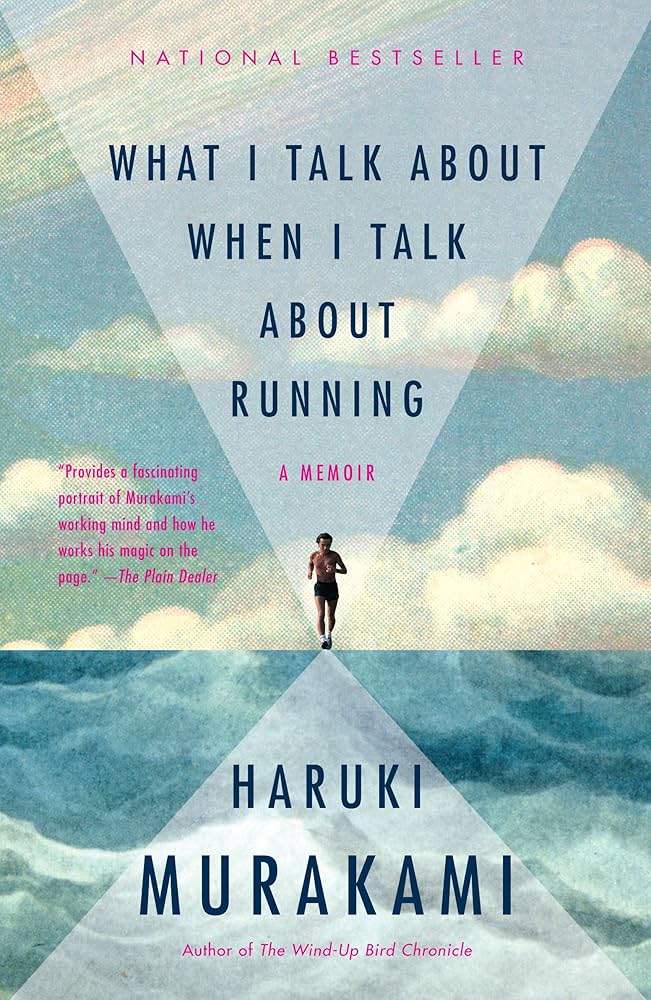
I just finished Haruki Murakami’s memoir-ish writing/running book What I Talk About When I Talk About Running and I think it’s the clearest and most concise writing I’ve read about what it feels like to run. Picking this book up coincided with an attempt to ease back into running after a long, multi-year, pause. Somehow, during the endless Zoom meeting filled months of the pandemic, I fell off my habit of running two or three days a week. I’m not sure why. Maybe lingering knee pain. Maybe just a general malaise. I don’t know if my return to running will stick (I’m really just slow speed shuffling with alternating walk breaks–I recommend something like this app if you’re just beginning or coming back from a break). Perhaps the knee pain will return and I’ll have to take up swimming which, just like Murakami, I’m terrible at.
Murakami’s straightforward honesty got me hooked. This particular passage, his response to what he thinks about when he runs, rang true,
As I run I tell myself to think of a river. And clouds. But essentially I’m not thinking of a thing. All I do is keep on running in my own cozy, homemade void, my own nostalgic silence. And this is a pretty wonderful thing. No matter what anybody else says.
It’s funny that I’ve never thought about this question, but I realized I have the same experience as Murakami. I don’t think about much of anything while I’m running. Like him, I put on some music and just run. Sometimes a vague idea will pop in my head but, as Murakami says, “I run in order to acquire a void”. For me running lets me escape the constant chatter and overthinking I’m prone to. It clears that clutter and, in my experience, uplifts my mood for the rest of the day.
This wasn’t always the case for me. I discovered running sometime in my late 20s and hated sports and physical education in school. With a few notable exceptions, in my experience, the very worst teachers were in charge of PE. Running was often meted out as punishment, a practice that really needs to stop. Murakami says,
Whenever I see students in gym class all made to run a long distance, I feel sorry for them. Forcing people who have no desire to run, or who aren’t physically fit enough, is a kind of pointless torture. I always want to advise teachers not to force all junior and senior high school students to run the same course, but I doubt anybody’s going to listen to me. That’s what schools are like. The most important thing we ever learn at school is the fact that the most important things can’t be learned at school.
Running is a divisive subject. Some love it and some really hate it. There doesn’t seem to be many people between these two poles, though many people force themselves to run. I have no idea if non-runners will enjoy Murakami’s book but its wisdom extends far beyond the usual feel good article in a running magazine and could also be read as a book about writing.
Murarkami is in much better shape than I ever was. He can run for miles every day. I can only run, at most, every other day and I have to do considerable work at the gym to prevent injuries. And I’ve had many injuries. These injuries have taught me to, as I think of it, “look above the problem.” If you have foot pain it often involves the calve. Knee pain involves the hips. You can keep going up the body until you reach the seat of consciousness itself and therein, running can teach us life lessons, not the facile life lessons found in airport self help books, but something deeper. Here’s a few I underlined:
“Pain is inevitable. Suffering is optional”
“I don’t think we should judge the value of our lives by how efficient they are.”
“If I’m asked what the next most important quality is for a novelist, that’s easy too: focus—the ability to concentrate all your limited talents on whatever’s critical at the moment.”
“No matter how long you stand there examining yourself naked before a mirror, you’ll never see reflected what’s inside.”
I may be counting my chicks before they’ve hatched. I’ve only been back to running for a month and I know, all to well, how easy it is to push too hard and end up with an injury that can take a very long time to recover from and, at this point, might end my running for good. Like Murakami I have to accept the inevitability that my running days will draw to a close someday. But until that time I hope to enjoy the great clearing of the mind that running provides.